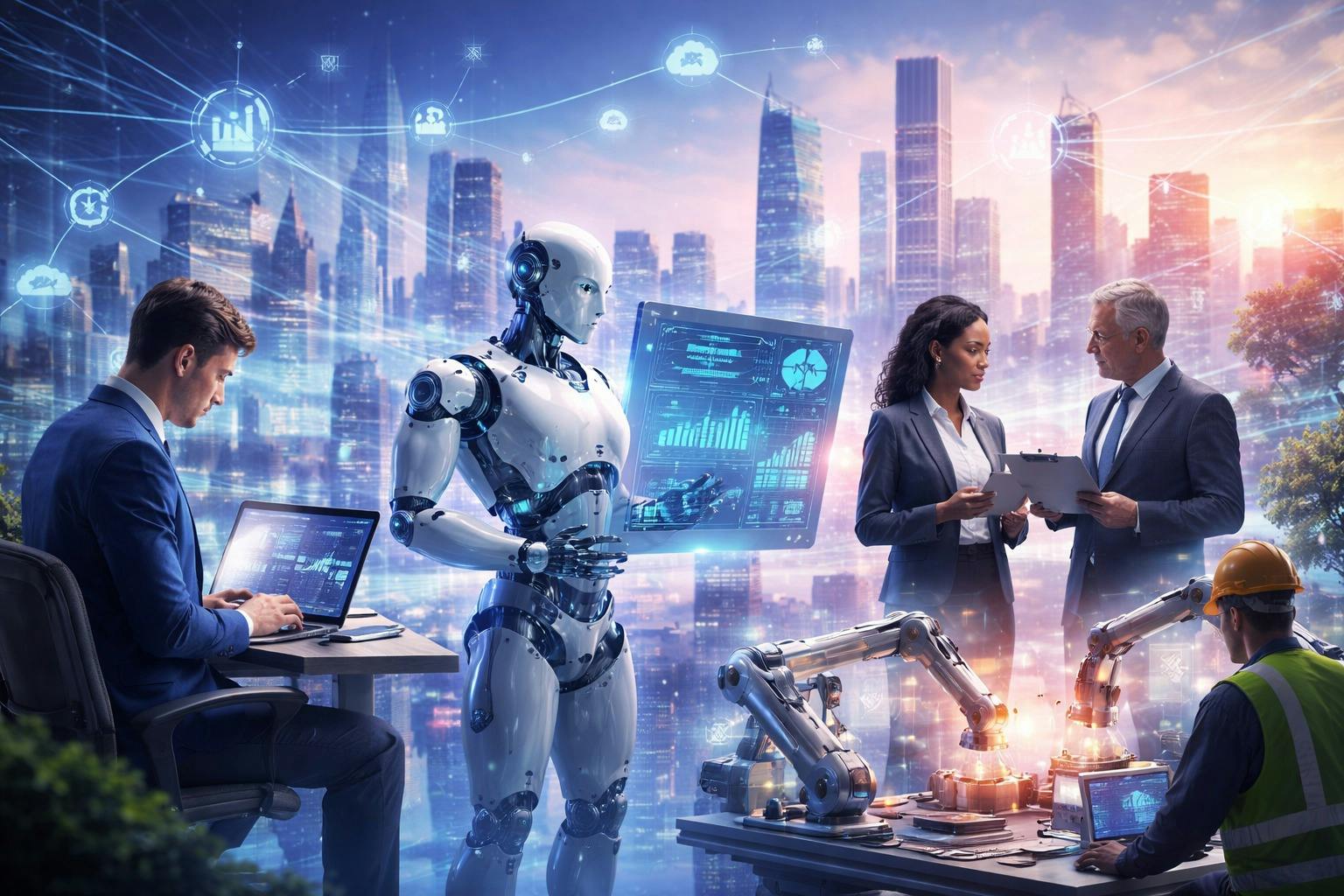
As artificial intelligence (AI) continues to evolve at an accelerated pace, it raises an urgent question for workers, businesses, and policymakers alike: Will AI advancements ultimately lead to widespread unemployment? This concern, though valid, is far from unprecedented. Historically, technological revolutions have triggered similar waves of anxiety, only for the long-term outcomes to demonstrate a more optimistic narrative. Rather than eliminating the need for human labor, each wave of innovation, be it the steam engine, electricity, or the personal computer, has reshaped the job landscape, creating new roles even as old ones faded. This article examines whether AI is likely to follow the same trajectory, exploring historical analogues, global economic implications, and the timeline for realizing productivity gains. With a balanced lens rooted in data and historical precedent, we find that while AI will undoubtedly cause disruption, it is unlikely to produce a permanent decline in employment.
Historical Lessons from Technological Disruption
The fear of machines replacing human workers is as old as mechanization itself. During the Industrial Revolution, the Luddites famously destroyed textile machinery they believed threatened their livelihoods. While their fears were understandable, history tells a different story. Mechanization drastically reduced the cost of goods, thereby increasing demand and creating new types of employment. For example, the automated loom made cloth more affordable, leading to the expansion of the textile industry, which in turn created jobs in management, marketing, distribution, and maintenance.
A similar pattern unfolded during the early 20th century. Henry Ford’s introduction of the moving assembly line tripled automobile production and cut costs significantly. Rather than resulting in mass layoffs, this innovation fueled demand and led to a hiring surge. Employment in the automotive sector expanded rapidly, catalyzing growth in adjacent industries like steel, rubber, and road construction. It also contributed to the rise of suburbanization and new service-sector jobs.
During the late 20th century, the proliferation of computers and ATMs provided another real-world test case. Contrary to popular belief, the number of bank tellers in the U.S. increased after the introduction of ATMs. While machines took over cash-dispensing tasks, human tellers began focusing on customer service, sales, and complex transactions. The shift didn’t destroy jobs; it changed them. Similarly, though some occupations like typists and travel agents declined due to digital platforms, entire new industries like software development, cybersecurity, e-commerce has emerged and flourished.
A comprehensive McKinsey study found that since 1960, U.S. productivity and employment have risen together 79% of the time. Over longer five to ten year spans, this co-movement becomes even more consistent. During periods of rapid technological advancement, total employment usually grows, albeit with significant reallocation among sectors. This concept of "creative destruction" is central to understanding labor dynamics. While some roles become obsolete, others are born, often in sectors that did not exist before.
Present-Day Evidence and Short-Term Outlook
Today’s AI boom is often compared to the arrival of electricity or the internet in its transformative potential. However, unlike past waves, AI has the capacity to automate not just manual labor but also cognitive tasks such as data analysis, customer service, and even creative writing. This raises the question: is this time different?
In the short term, empirical data suggest a more tempered impact. According to Brookings (2024), there has been no detectable rise in unemployment among occupations most exposed to AI since the public launch of ChatGPT. While job postings for highly automatable roles like data entry and transcription have declined, other sectors have remained stable or even grown. This mirrors previous technology cycles where displacement was gradual and offset by gains in new roles.
A Goldman Sachs report estimates that only 2–3% of current U.S. jobs are at high risk of full automation by AI in the next decade. Even in a more aggressive scenario, where up to 7% of jobs are affected, the impact on overall unemployment would likely be modest and temporary. Historical patterns show that productivity improvements tend to increase employment after an initial adjustment period. For every 1% increase in productivity, unemployment rises by about 0.3 percentage points before reverting to the mean.
The World Economic Forum’s 2023 Future of Jobs Report echoes this outlook. It predicts that 69 million new jobs will be created globally by 2027 due to AI and digital technologies, offsetting the 83 million jobs expected to be displaced. Crucially, most of these new roles will arise in previously underdeveloped sectors such as green energy, data science, and healthcare. Moreover, companies are not only preparing to automate but also to retrain. According to the report, 44% of worker skills will need updating in the next five years, highlighting a proactive response from employers.
Sector-Specific Impacts
The impact of AI will differ across industries, depending on the nature of work, regulatory constraints, and capital availability. Some sectors will experience widespread task automation, while others will benefit from augmentation, where human capabilities are enhanced by intelligent systems.
The impact of AI will differ across industries, depending on the nature of work, regulatory constraints, and capital availability.
Manufacturing & Logistics: Automation has already been prevalent in this sector, and AI is expected to improve supply chain efficiency, predictive maintenance, and quality control. While some repetitive jobs may be lost, skilled technician roles are on the rise.
Finance & Insurance: AI tools now handle fraud detection, customer onboarding, and credit scoring. This reduces the need for clerical staff but increases demand for AI specialists and compliance officers.
Healthcare: AI augments diagnostics and administrative tasks, enabling physicians and nurses to focus more on patient care. The sector is projected to experience net job gains due to aging populations and increased demand for health services.
Education: AI tutoring systems and administrative automation are enhancing learning but not replacing educators. Instead, roles are evolving to emphasize emotional intelligence and personalized instruction.
Retail & Customer Service: Chatbots and recommendation engines are displacing some human roles. However, jobs in logistics, inventory management, and customer experience remain resilient.
Construction & Skilled Trades: These jobs involve complex physical environments, making them hard to automate. As such, they remain among the least exposed to AI disruption.
Additionally, emerging job roles across sectors are reshaping the talent landscape. For instance, in manufacturing, roles like robotics technicians, AI model trainers, and supply chain data analysts are in high demand. In finance, risk modeling experts who can interpret AI outputs and regulators with data science literacy are becoming indispensable. Healthcare is seeing the rise of digital health coordinators and medical data analysts. Education is beginning to integrate AI curriculum developers and platform moderators to manage hybrid learning environments. These changes are prompting a global surge in upskilling initiatives. Companies like Amazon and IBM have launched in-house training programs, while national governments, such as Singapore and Germany, are investing heavily in AI literacy and vocational reskilling programs. These targeted initiatives are helping smooth the transition for workers whose roles are evolving.
Table 1: Estimated AI Exposure and Economic Impact by Region
|
Region |
AI Exposure (Approx.) |
Jobs at Risk Estimate |
Projected GDP Impact (2030s) |
|---|---|---|---|
|
Advanced Economies |
25% of labor tasks |
6-7% of total jobs |
+0.3 to +0.4 pp annually |
|
Emerging Markets |
10-20% |
~5% |
+0.2 to +0.3 pp annually |
|
Low-Income Countries |
<10% |
~3% |
Minimal; delayed impact |
As seen in Table 1, advanced economies face higher AI exposure and thus greater initial disruption. However, they also stand to gain the most in terms of GDP growth due to better digital infrastructure, higher skill levels, and more capital for investment. Emerging and low-income countries, by contrast, face less immediate pressure but may risk falling behind if they fail to build the necessary foundations for AI adoption.
Timeline for AI’s Productivity Payoff
Understanding when the benefits of AI will fully materialize is key to shaping expectations. Historically, general-purpose technologies such as electricity and the internet took decades to manifest visible productivity gains across the economy. AI appears to be following a similar trajectory. According to Goldman Sachs, AI will begin contributing significantly to U.S. GDP growth around 2027, with more substantial productivity dividends arriving by the mid-2030s. These gains will not be immediate because widespread adoption depends on integration into core processes, retraining of workers, and the evolution of business models.
McKinsey projects that about 50% of today’s work activities could be automated by 2045. Productivity growth is expected to accelerate gradually, with annual gains ranging from 0.1 to 0.6 percentage points depending on the speed and scale of AI adoption. The slow ramp-up reflects the time needed for businesses to pilot, refine, and scale AI solutions, as well as regulatory and societal constraints that affect adoption.
Industry variation will also shape this timeline. High-tech and finance sectors may realize benefits sooner due to digital readiness, while sectors like construction, government services, and hospitality may lag. A World Economic Forum survey reveals that only 9% of U.S. firms had implemented generative AI in production by 2024, indicating a long runway ahead. However, as infrastructure matures and competitive pressure increases, adoption is expected to accelerate.
The Global Outlook and Productivity Timeline
The macroeconomic impact of AI will largely depend on how quickly and effectively it is adopted. Goldman Sachs predicts that AI will begin significantly affecting U.S. GDP growth around 2027, with the most substantial gains realized by the mid-2030s. These gains could contribute an additional 0.3 to 0.4 percentage points to annual GDP growth in advanced economies.
McKinsey's models offer a longer view, suggesting that up to 50% of work tasks could be automated by 2045, accelerating productivity growth by 0.1 to 0.6 percentage points per year. These projections are contingent on investment in complementary technologies, workforce training, and business process redesign. Without these enablers, the benefits of AI may be unevenly distributed or significantly delayed .
Meanwhile, the World Economic Forum reports that AI's broader economic gains will emerge gradually, as firms pilot new applications, test for accuracy, and train employees. Only 9% of U.S. firms had implemented generative AI tools in production environments as of 2024, underscoring the gap between technological capability and practical deployment.
Table 2: Generative AI Adoption and Value by Sector (Global Estimates)
|
Sector |
Annual Value from GenAI |
Example Applications |
|---|---|---|
|
Banking & Finance |
$200–$340 billion |
Risk analysis, fraud detection |
|
Healthcare |
$60–100 billion |
Diagnostic assistance, documentation |
|
Retail and Consumer |
$400–600 billion |
Supply chain optimization, virtual agents |
|
Manufacturing |
$300–450 billion |
Quality control, predictive maintenance |
The data and decision-making sectors will receive the most benefits from generative AI, as shown in Table 2. But the gains will need to be realized at scale and also take workforces through widespread adoption, with support from policies that will provide it for workers.
Policy Implications and the Path Forward
This requires a wide and future-oriented policy approach to making sure that the capabilities of AI are optimized while preventing outlay is in line with tomorrow while minimizing disruption. Governments must address 4 pillars: education, labour sector shift support, rewards for innovation, and ethical AI regulation. Education at least needs to speedily adapt, that is what will enable such systems to teach fluency with the digital language and critical thought and critical thinking. Meanwhile, many of the countries involved in this integration, including Finland and Singapore, are incorporating AI and coding into their early educational curricula. Vocational and tertiary education needs to be closely catered to the job market, with skills especially in data literacy, systems thinking and AI ethics.
During the transitional period, there are skill gaps faced by workers, so public and private lifelong learning platforms can help address them. Second, strong safety nets need to be there. That includes wage insurance, retraining grants, job placement services and mental health support for those displaced. Germany’s Kurz Arbeit scheme, which subsidizes wages whenever companies are temporarily down, has been argued to offer successful examples of dealing with structural changes. The U.S., U.K. and Canada have created or expanded apprenticeship programs aimed at bolstering industrial retraining practices. Third, responsible innovation should be incentivized in policy. Governments can offer tax breaks or grants for companies that can invest in retraining workers through the same launch of AI that they are currently making. AI in industries like agriculture, logistics, and public health can also be leveraged with the assistance of public-private partnership models.
A third important element that AI governance must embrace and work for is transparency, accountability, fairness. The European Union’s AI Act also provides a risk regime for regulation that enables stringent risk control for such high-risk uses, for example biometric surveillance, or algorithmic employment and finance decision-making. Now, similar frameworks are being discussed in Canada, Brazil and Australia. Those efforts both seek to protect people from exploitation and encourage innovation. Governments therefore are very important for deciding how to deal with AI and how the labor market will react. Policies that promote digital literacy, increase access to higher education and provide highly focused retraining will be vital. So, too, must social safety nets evolve to assist workers in transition. These include wage insurance, mobility subsidies and portable benefits that counter-mandate the short-term impacts of displacement.
Investment in AI infrastructure, whether broadband access or cloud computing capabilities, will be key to how evenly AI’s benefits spread. Without these investments, rural areas and low-income countries would be left behind. Business also must take on the blame. Ethical use of AI and algorithms, transparency on algorithmic decision-making, as well as fair and equitable recruitment will help build public trust and community solidarity going forward. Tech companies are already integrating AI into their businesses, not just as a “cheap” path but also as a way of fostering innovation and hiring new and enhanced workers.
The Bottom Line: Growth in an Emerging World
The prevailing story of AI and jobs can swing between alarm and idealism. But historical trends, and contemporary forecasts, will suggest a compromise: AI will disrupt, not eradicate, jobs. No, it’s going to be a force multiplier, boosting productivity and creating new economic value. The sectors that look set to gain the most would be those that deploy AI not as a tool to replace themselves, but as a facilitator with a common expertise. For example, in healthcare and education, AI can save the burden of administrative staffs and provide the professionals time for more valuable people centric work.
In some areas, including logistics, agriculture and energy, the newly artificial intelligence-enabled efficiencies are creating new business models that cut cost. Business leaders, workers and governments need to be ready for a new balance. It will be an ongoing process of learning, sharpening skills, and shared interaction with the human-machine interaction. It’s whether this transition is accelerating and inclusive that will determine whether AI exacerbates inequality vs shared prosperity. Nations who invest early in digital infrastructure and lifelong education are likely to enjoy productive growth and employment growth over decades to come.
Conclusion
AI isn’t a silver bullet, nor a scourge. It’s a transformative force that, like electricity or the internet, is going to fundamentally rework and refashion the global economy. The data suggests that while some jobs will vanish, many others will develop, transform in some way, and evolve to be new and different. Short term disruptions are legitimate, but manageable, if policies and investment in human capital are provided. Ultimately, whether AI will be a boon to unemployment or a boon to productivity and innovation is not a question of how tech will work. History tells you that change will unfold; decay doesn’t. The intelligent use of AI development can pave the way to an era of inclusive growth, productivity growth, and decent employment for all.
After all, the ultimate question about whether artificial intelligence will increase unemployment isn’t something that headlines about joblessness or temporary disruption will be able to answer. History and economics, as well as early empirical evidence, point to a more complex, and ultimately constructive, answer. AI, by analogy with electricity, mechanization and the internet before it, is a general-purpose technology, one that is more about redefining how work is done than it is a means of eliminating work entirely.
When productivity is translated into economic expansion there can be no doubt that occupations and tasks will suffer a decline however, the overall labor market is more resilient than people generally assume. What sets AI apart from earlier technologies is not the inevitable job loss, it’s the speed and scope of the task transformation. But AI accelerates change, turning all those years that once took decades into years. This acceleration has real adjustment problems: workers need to reskill more quickly; firms need to reimagine job design and governments need to modernize labor and education systems to address the new realities. But acceleration does not imply a collapse. Indeed, productivity-driven growth historically expands demand across the economy, which in turn creates new job types in places that are typically impossible to foresee.
Most of the rapidly expanding professions of today like data scientists, cybersecurity analysts, digital marketers, were hard to imagine a generation ago. More crucially, the long-term employment impact of AI will rely less on the technology and more on institutional choices. It is economies that invest in human capital and in lifelong learning, align education to the ever-changing skills requirements that are most likely to see AI adoption and growth co-existing, and not lead to structural unemployment. But that means countries and organizations that only see AI as a cost-cutting tool will only worsen inequality and social friction. Both job displacement and job transformation are about policy design, corporate strategy and workforce preparedness.
The true promise of AI is that we are working to augment, not replace, humans with this information removing them from the mindless, monotonous work that tends to make low-value decisions possible, enabling them to instead focus on judgment, imagination and other human capabilities, such as empathy and complex, high stakes decision making. As AIs mature, they will become more likely to work together than against one another, bringing about wider productivity increases across fields ranging from health care and education, to manufacturing and finance. AI by this perspective doesn’t end work but initiates a phase of work, something that’s more fluid, skill-based and perhaps more fulfilling. And finally, AI won’t itself determine jobs’ future. Human choices will. When deployed wisely, AI could become one of humanity’s most potent engines of economic growth and opportunity in our modern era rather than being a harbinger of mass unemployment, it would be a catalyst toward an increasingly efficient and flexible workforce.
References:
- Acemoglu, D., & Restrepo, P. (2018). Artificial Intelligence, Automation, and Work.
- Autor, D. (2015). Why Are There Still So Many Jobs? The History and Future of Workplace Automation.
- Bessen, J. (2015). Learning by Doing: The Real Connection Between Innovation, Wages, and Wealth.
- BIS. (2023). The Macroeconomics of AI.
- Brookings Institution. (2024). AI Labor Market Tracker.
- Goldman Sachs. (2023). The Potentially Large Effects of Artificial Intelligence on Economic Growth.
- McKinsey Global Institute. (2023). The Economic Potential of Generative AI.
- World Bank. (2023). AI and the Global Labor Market.
- World Economic Forum. (2023). Future of Jobs Report.
- Bank for International Settlements. (2023). AI and the Future of Work.
[story continues]
tags