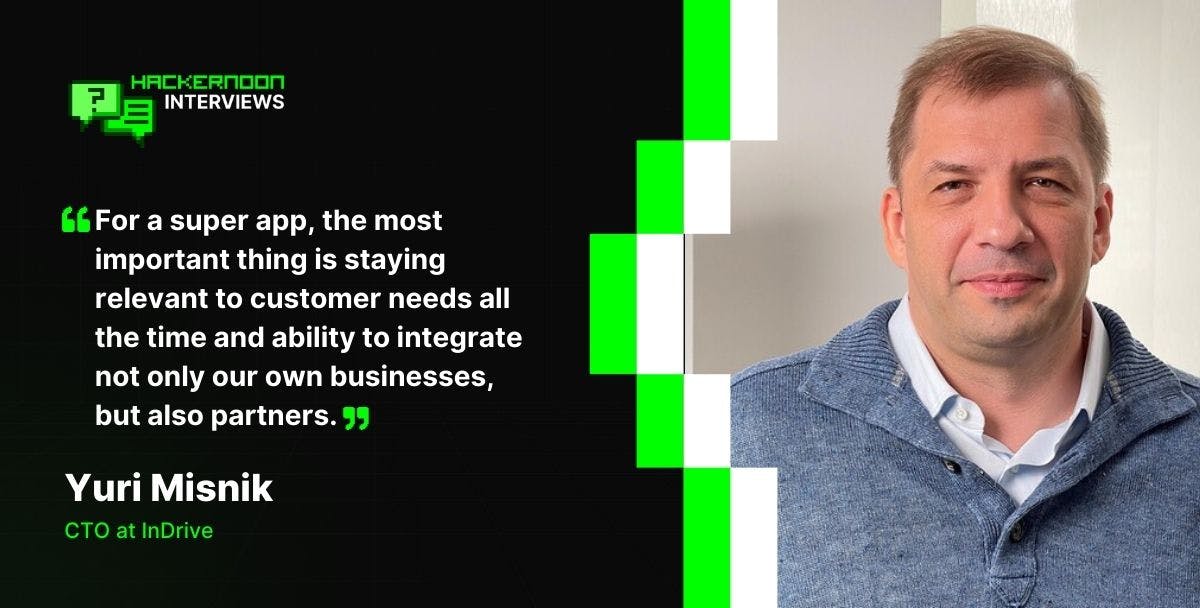
We’re excited to welcome Yuri Misnik, Chief Technology Officer at inDrive, for a conversation on scaling technology, AI innovation, and building a lean and strong engineering organization. Yuri brings decades of global leadership experience across major technology and financial services organizations, having held senior roles at companies including Microsoft and AWS.
At inDrive, Yuri oversees the company’s engineering, AI, and data teams as the platform evolves from a leading ride-hailing service into a full-featured super app. In this interview, we explore what energizes him about this transformational stage at inDrive, how technology is influencing the company’s trajectory, and the leadership principles that guide his approach to lean yet impactful engineering.
1) Congratulations on your recent appointment as CTO at InDrive! What excites you most about leading engineering, AI, and data teams at such a transformative stage for the company?
What excites me most is the combination of scale and growth in a very customer-centric purpose-driven business. We’re not only big in terms of customers and drivers — we’re expanding into a super app, building grocery verticals, and moving into adjacent domains. That means we’re creating a technology platform and a technology organization that is not only scalable and robust on a global level, but also truly customer centric and data-driven.
The second part is the opportunity to be building something modern by design: using AI (in a broad sense) everywhere makes things better and faster, helps us servicing customers efficiently and stay relevant to their needs. Doing that at the pace we’re growing is a challenging engineering problem — and also an exciting organizational challenge.
2) InDrive has scaled from a ride-hailing app to a full-fledged “super app.” How do you see technology driving this next phase of diversification?
For a super app, the most important thing is staying relevant to customer needs all the time and ability to integrate not only our own businesses, but also partners. We want to build an app and a platform that fulfills everyday needs — mobility, grocery, and more — and to do that well, it has to be consistently relevant to each person and flexible to integrate multiple businesses at pace.
Relevance is driven by data, analytics, AI, and machine learning: extracting what truly matters for a specific customer and making the experience always personalized — what we call a “segment of one.” This requires strong foundations: big data platforms, data lakes, and modern ML/AI capabilities, along with the engineering and operations to run them reliably at scale.
Integration on the other side is driven by a robust well-designed API-first platform which is simple to understand, operate and maintain.
3) You mentioned leading an AI transformation that re-architects pricing, safety, and support through agentic workflows. Could you unpack what that transformation looks like on a technical and cultural level?
On the technical level, it starts with building the right platforms: data lake, data pipelines, data quality layers and the model management infrastructure that enables advanced ML usage. And one of the imperative today is to have a comprehensive semantic layer that enables modern AI scenarios, especially generative and agentic ones. A big part of this is building a robust data science and machine learning platform with embedded MLOps and related practices.
We’re also intentional about not building everything from scratch, but using strong building blocks from the market — for example, combining AWS SageMaker with Databricks capabilities — and picking what’s best to drive our advantage.
On the cultural level, it’s about learning how to make AI work for us as a company. We’re deploying different agents internally, observing how they perform, and learning what we need to change in our processes and data to make those agents truly useful. Over time, we’ll also introduce more agents for customers, drivers, suppliers — which changes interaction patterns toward truly conversational assisted interfaces, via chat or voice. Agents can become meaningfully helpful to everyone in our ecosystem: helping them make better decisions, find the best deals, and optimize how they use the platform.
4) InDrive has always prided itself on fairness and transparent pricing. How does AI fit into that philosophy without introducing bias?
I don’t see AI and fairness as inherently contradictory. We already use machine learning in supply-and-demand models to ensure we have the right amount of cars on the road and can match customer demand. And we are doing it in a responsible and transparent way, always staying true to our purpose of fighting injustice.
The key is being careful about the data we select and how we train models, making sure we are optimising them for the benefits of our customers, not for profit. We also deliberately position advanced AI and agents as a recommendation and helper, not an ultimate black-box decision maker. In our ride-hailing model, pricing is fundamentally based on negotiation between the customer and the driver. Models can recommend an optimal range to help the agreement happen faster and more smoothly, but we’re explicit that control and final decision stays with our customers and drivers. Transparency and user control are the guardrails.
5) You share “doing more with fewer resources” as a guiding principle. What are your frameworks or philosophies for building lean yet high-performing engineering teams?
We’re very deliberate about using our resources efficiently and adding more only if we absolutely need it: we look closely at what teams do and what their real workload is, we constantly optimise our cloud usage and architectures for cost. Most teams are lean, cross-functional product teams — typically a couple of frontend engineers, a couple of backend engineers, and QA — and we push for full end-to-end ownership.
We also prioritize seniority and decision power in teams: fewer “clipboard roles,” more people who can make decisions and execute quickly.
We have built a very effective devops platform for our teams to use on AWS which is our global cloud provider. It allows us to completely automate all the routine tasks for environment provisioning and management, deployment, testing and broader feature rollout. We also use autoscaling efficiently to make sure we always have the optimal amount of resources serving our workloads and teams are more and more getting accountability for finops practices they use.
Another major lever is automation and AI agents in areas that add less differentiation — for example, documentation support, testing, requirements analysis. We’re starting to introduce AI agents to help create more tests with fewer people and reduce manual overhead. This isn’t only about efficiency: automation improves resiliency, robustness, and quality by reducing mistakes. Cost-consciousness and keeping teams lean is part of the operating philosophy.
6) Many tech companies face the challenge of balancing innovation velocity with EBITDA discipline. How do you architect a technology strategy that serves both speed and profitability?
There’s no universal answer, but for us a few principles matter.
First, we focus on building what truly differentiates us rather than building everything from scratch. We are cloud-native — all of our infrastructure runs on the cloud, mostly AWS and Google Cloud — and we rely heavily on fine-tuned auto-scaling so our infrastructure capacity always matches demand.
We also continuously optimize. We have strong platform teams, but we also push cost ownership into product teams by introducing FinOps practices: giving teams clear visibility into what things cost — cost per ride, cost per transaction, even cost per database call. We track cost per ride as a KPI and aim to keep it flat or decreasing over time as we grow, so we scale with discipline.
7) Building a world-class engineering organization requires not just systems, but culture. How are you cultivating a sense of ownership and purpose among distributed teams?
A lot of it comes down to communication and alignment: bringing people together (even virtually), sharing common goals, and keeping everyone connected to the purpose, strategy and shared context.
Structurally, we rely on cross-functional product teams built around shared outcomes, with clear goals and strong ownership. We’re also lucky that even when remote, many teams operate within similar time zones, which makes collaboration easier. And we intentionally keep teams small and lean, because smaller teams communicate better and can stay aligned on shared goals more naturally.
8) Having led tech at large organizations like Microsoft, AWS, HSBC, National Australia Bank, and now InDrive, what key leadership lessons have stuck with you across industries?
The biggest lessons aren’t industry-specific.
First, you can only be an effective leader if you genuinely care — about customers, your business, about your team and ultimately about the technology choices. That mindset becomes visible and contagious.
Second, leadership is not about making every decision. It’s about enabling others to be the best versions of themselves and consistently make good decisions. It is also about aligning the organization on shared goals, removing blockers, and practicing servant leadership — providing tools, context, and autonomy rather than becoming a bottleneck.
Third, you need a clear mission, vision and shared purpose — not just “strategy,” but the core principles you build technology, organization, and people capabilities around. And finally, being genuine, honest, and transparent with the team is needed as part of your core personality.
9) How do you personally stay grounded and continue learning amid the pace of AI disruption? Any frameworks or habits you rely on?
I don’t have a strict framework, but I’m intentional about inputs. I use my network and what I see through places like LinkedIn, Reddit and some of the blogs I read regularly to stay broad and understand the context of what is happening in the industry, and then I go deeper on topics that matter.
I also spend a lot of time reading — I prefer books over videos — and I try to read about something new for me every day, even if it’s only for 15 minutes. AI can also be a useful helper to structure thinking and guide exploration when you’re learning something new, but it doesn’t replace the work of learning — it complements it.
10) If we revisit this conversation in three years, what do you hope InDrive’s technology story will look like, both in terms of global reach and ethical innovation?
In three years, I’d love to say we are a company that made a significant impact in fighting injustice and creating opportunities for people and communities through technology and through the tech-enabled businesses we and our partners run — ride-hailing, grocery, and beyond.
I also want us to have a very capable technology team that’s recognized worldwide for innovation and forward thinking — and a culture where people genuinely care about our customers, our business, and our purpose and mission. As we scale, I hope we stay transparent and fair — fair to ourselves, to customers, and to suppliers. Efficiency will remain a core principle, because being efficient translates directly into customer value, and I hope we stay true to that mission as the business grows.
[story continues]
tags