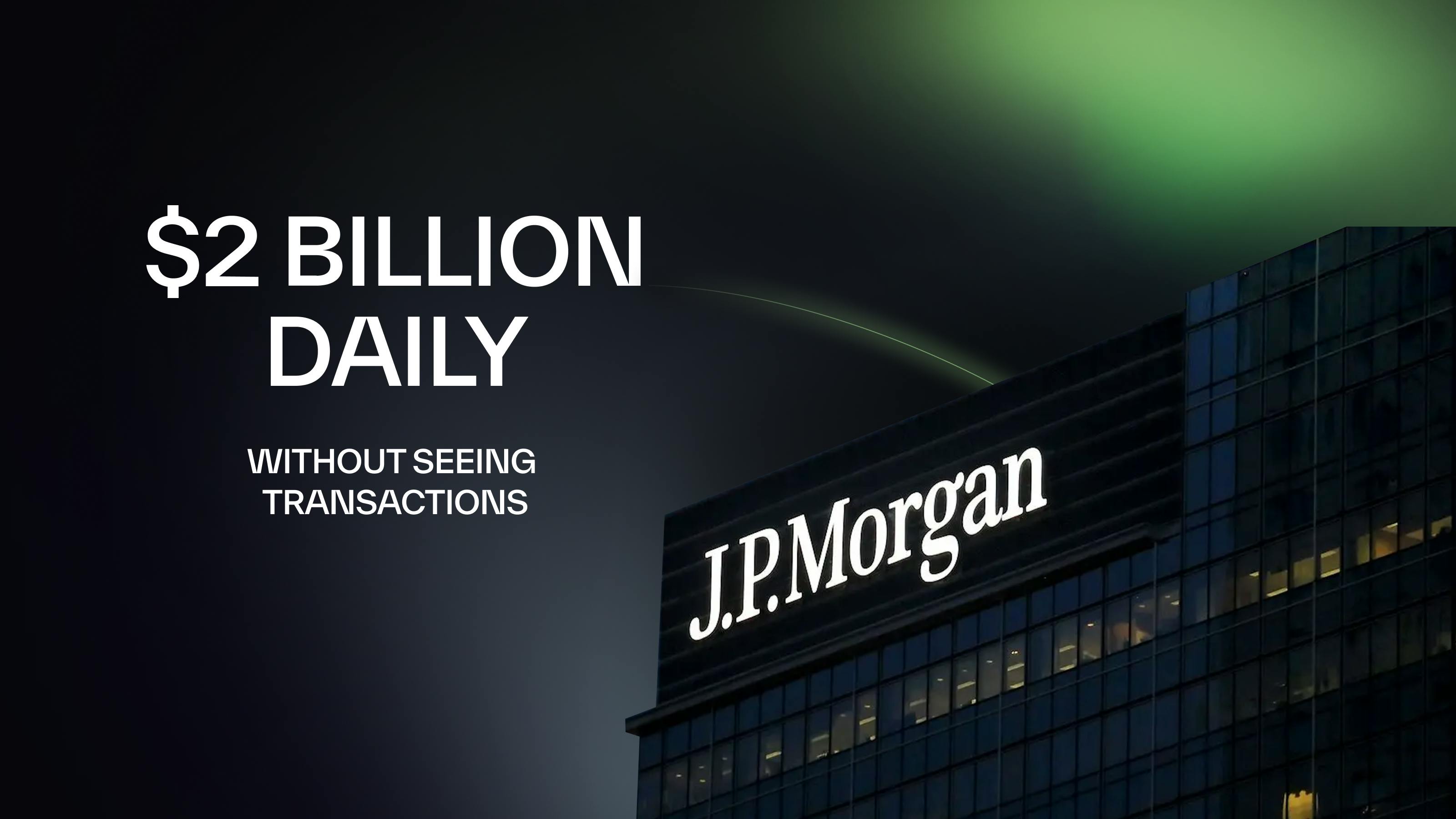
Why JPMorgan, Deutsche Bank, and SWIFT are betting on zero-knowledge cryptography to solve the impossible privacy problem. Here's the problem that's plagued digital commerce since day one: how do you prove you know something without revealing what you know?
Imagine proving you're over 21 at a bar without handing over your driver's license with your name, address, and exact birthdate. Or convincing your bank you have sufficient funds without disclosing your account balance or transaction history. For decades, this seemed impossible. You either revealed everything or proved nothing. Then mathematicians found a loophole in logic itself using zero-knowledge proofs.
Zero-Knowledge Proofs: The Technology Wall Street Uses
Zero-knowledge proofs sound theoretical, but they're processing real money right now. JPMorgan moves $2 billion daily through blockchain systems using zero-knowledge technology. Deutsche Bank is building an entire Layer-2 blockchain with zero-knowledge proofs. UBS tokenized $1.7 billion in private credit using zero-knowledge cryptography.
The zero-knowledge proof market tells the story: valued at $83.6 million in 2025, projected to hit $10.2 billion by 2030. Institutions are discovering zero-knowledge proofs are the only cryptographic method that can simultaneously satisfy privacy requirements and regulatory compliance.
The timing makes sense for zero-knowledge technology adoption. Healthcare suffered 385 million patient record breaches from 2010 to 2022. Data privacy regulations tighten globally every year. Companies need ways to verify information without exposing it to breaches, competitors, or even their own employees.
Zero-knowledge proofs solve this mathematically, provably, and at scale.
How Zero-Knowledge Proofs Actually Work
Think of zero-knowledge proofs as computational escrow. In real estate deals, an escrow agent holds funds and documents, releasing them only when conditions are verified. The agent sees everything: your bank statements, the seller's title, all the details. Zero-knowledge proofs replace that trusted intermediary with mathematics. Instead of showing someone your data and trusting them to keep it secret, you generate a cryptographic zero-knowledge proof they can verify independently. No trusted middleman required.
Three Rules of Zero-Knowledge Proofs
Every zero-knowledge proof must satisfy three rules:
- Completeness in zero-knowledge proofs: If something is true, you can prove it. A company with legitimate $50 million revenue can demonstrate it to auditors using zero-knowledge technology.
- Soundness in zero-knowledge cryptography: If something is false, you can't fake the proof. The odds of forging a valid zero-knowledge proof are 1 in 2^256, smaller than finding a specific atom in the observable universe.
- Zero-knowledge property: The proof reveals nothing beyond the statement's truth. An auditor learns revenue exceeded the threshold but gains zero information about the actual number, customer list, or profit margins through zero-knowledge verification.
Zero-Knowledge Proofs Example: Mortgage Applications
Here's a real example of zero-knowledge proofs in practice. You're applying for a mortgage. The traditional process means handing over tax returns, bank statements, employment letters.
With zero-knowledge proofs, you prove your income exceeds $150,000 without revealing it's actually $167,250. You prove your debt-to-income ratio is below 43% without showing your car payment or student loans using zero-knowledge cryptography. The bank gets mathematical certainty. You keep your privacy.
From MIT Lab to Production: Zero-Knowledge Proof History
In 1985, MIT researchers Shafi Goldwasser, Silvio Micali, and Charles Rackoff published "The Knowledge Complexity of Interactive Proof-Systems." Their zero-knowledge proof breakthrough eventually earned them the Turing Award. But zero-knowledge technology was impractical for 25 years. Early zero-knowledge proofs required multiple rounds of back-and-forth communication and massive computational power.
Three Breakthroughs in Zero-Knowledge Proofs
- 1986: The Fiat-Shamir technique converted interactive zero-knowledge proofs to non-interactive ones. One message, no back-and-forth. Like replacing phone authentication with a certificate anyone can verify anytime.
- 2012-2013: Short zero-knowledge proofs emerged at under 300 bytes, verifying in milliseconds. Blockchain applications using zero-knowledge technology became possible.
- 2016: Zcash launched as the first major cryptocurrency using zero-knowledge proofs. JPMorgan noticed. Enterprise zero-knowledge exploration began.
By 2024, zero-knowledge technology reached production scale. zkSync processed 230 million zero-knowledge transactions in 2024. By 2030, projections estimate 600 billion zero-knowledge transactions as the technology extends beyond blockchain into enterprise applications.
Three Types of Zero-Knowledge Proofs: SNARKs, STARKs, and Bulletproofs
The zero-knowledge proof landscape has three main architectures:
zk-SNARKs: Zero-Knowledge Short Proofs
zk-SNARKs (Short Non-Interactive Arguments of Knowledge) are the compact zero-knowledge choice. Proofs of only 200-300 bytes that verify in under 10 milliseconds. JPMorgan, zkSync, and most financial applications use SNARK zero-knowledge proofs because their tiny size minimizes blockchain storage costs.
The tradeoff: SNARKs require a "trusted setup" ceremony where zero-knowledge cryptographic parameters are generated through multi-party computation. If compromised, fake zero-knowledge proofs could theoretically be created.
zk-STARKs: Transparent Zero-Knowledge Proofs
zk-STARKs (Scalable Transparent Arguments of Knowledge) require no trusted setup and are quantum-resistant zero-knowledge proofs. They remain secure even against future quantum computers.
The tradeoff: STARK zero-knowledge proofs are 40-100x larger (100-200 KB vs 200 bytes). However, STARK zero-knowledge proof generation is 10x faster than SNARKs. StarkWare's StarkNet and dYdX exchange use STARK zero-knowledge technology.
Bulletproofs: Middle-Ground Zero-Knowledge Proofs
Bulletproofs occupy the middle ground in zero-knowledge cryptography. No trusted setup, smaller zero-knowledge proofs than STARKs (1-2 KB), optimized for specific use cases like range proofs. Monero adopted Bulletproofs zero-knowledge technology in 2018, reducing transaction sizes 80%.
zk-Rollups: Scaling with Zero-Knowledge Proofs
The newest zero-knowledge development is zk-rollups: systems that execute thousands of transactions off-chain, then submit compressed data plus a validity zero-knowledge proof to the main blockchain. Ethereum processes only 15 transactions per second on its base layer. zk-rollup systems like zkSync process 2,000 to 20,000 transactions per second using zero-knowledge proofs while maintaining Ethereum's security, with costs dropping from $3-50 to $0.10-1.00 per transaction.
Zero-Knowledge Proofs: The Future of Private Transactions
JPMorgan's $1.5 trillion in processed payments using zero-knowledge technology and Deutsche Bank's institutional blockchain development using zero-knowledge proofs show that major banks view zero-knowledge cryptography as foundational infrastructure for next-generation payment rails, asset tokenization, and privacy-preserving compliance.
The impossible puzzle has been solved with zero-knowledge proofs: proving you know something without revealing what you know. The question now is how fast the world catches up to zero-knowledge technology adoption.
[story continues]
tags